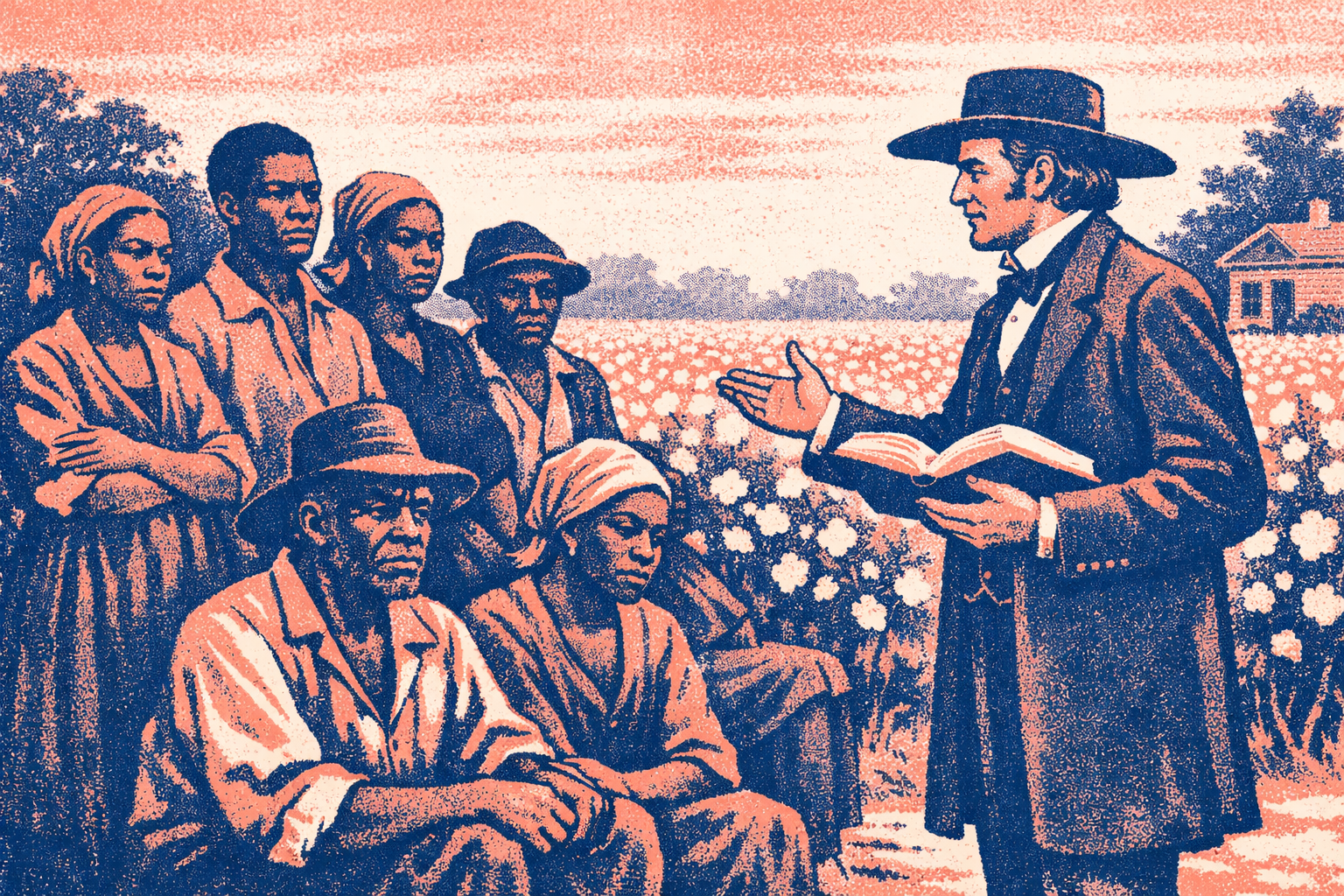

The Bible was used to defend slavery. To oppose it. And by millions of people who had no choice in the matter, simply to endure it. That’s the history — and it raises a question that American Christians have never answered satisfactorily: if scripture is the infallible word of God and the ultimate guide to morality, how did it end up on both sides of the most morally catastrophic institution in American history?
Scripture as a management tool
American slaveholders weaponized Christianity. The Bible was present at every level of the slave system:
- in the laws that governed it.
- in the courts that upheld it.
- in the churches that sanctified it.
Preachers were complicit in the whole operation.
The go-to text was the so-called “Curse of Ham” from Genesis 9. This is where Noah curses Canaan, the son of Ham, to be a “servant of servants.” Pro-slavery theologians bent this story into a racial justification for Black bondage, a reading with one serious problem: the text says nothing about race, nothing about Africa, and nothing about perpetual hereditary enslavement. None of that was in the Bible. It was supplied by men who needed a divine endorsement for something they’d already decided to do.
They also leaned on Leviticus 25, which permits the permanent purchase of foreign slaves, and Ephesians 6:5 — “Slaves, obey your earthly masters” — a verse quoted in isolation with remarkable consistency by people who never seemed to notice what comes a few chapters earlier about loving your neighbor. The pattern is familiar to anyone who pays attention: find the verse that supports what you want, ignore the verses that complicate it.
What the church was actually doing
This was social control with a cross on top.
By framing the slave system as divinely ordained, churches gave slaveholders something more valuable than legal protection: moral cover. Enslavement stopped being a crime against humanity and became a duty within a God-ordered hierarchy. White Christians sat at the top. Black people were property, and the Bible said so.
The practical consequences were stark. Enslaved people were fed sermons about obedience and submission. Access to the full Bible — especially stories about liberation, justice, and the image of God in every human being — was carefully controlled. Frederick Douglass, who lived it, described how slaveholders specifically used Christianity to make bondage more tolerable and resistance seem sinful.
The abolitionists were reading the same book
Here’s what complicates the simple narrative: the Christians who fought against slavery also used the Bible.
Quakers were the earliest and most consistent critics. Their theology centered on an inner moral light present in every person, which made the idea of owning another human being spiritually incoherent. They organized the first antislavery societies in America and kept the pressure on for generations.
During the Second Great Awakening in the early 19th century, a wave of evangelical ministers — particularly those in the Arminian tradition, which stressed individual moral accountability — began arguing that a Christian couldn’t own another soul and claim to be right with God. John Wesley had made a version of this argument in England decades earlier. William Wilberforce turned it into a 20-year parliamentary campaign that finally ended the British slave trade in 1807.
Same Bible. Radically different conclusions.
What enslaved people did with scripture
For Africans held in bondage, Christianity arrived as the religion of their oppressors. Slaveholders intended it that way: a tool to produce submission. What happened instead is one of the more remarkable episodes in American religious history.
Enslaved people took the same text being used against them and found something entirely different in it. The Exodus story became a blueprint: a people in bondage, a God who demanded their freedom, a system of power that ultimately collapsed under the weight of its own injustice. Nat Turner drew on scripture to justify rebellion. Harriet Tubman invoked it to lead people north. The words slaveholders used to demand obedience were the same words that sustained resistance.
Out of these readings and the communal practices built around them, the Black church emerged. It absorbed African traditions, shaped its own theology, and became the institutional backbone of Black life in America for the next two centuries. The theological fire it generated didn’t stay contained. It eventually ignited Pentecostalism itself.
What this history actually tells us
The abolition of slavery didn’t come from a new discovery in the Bible. Nobody found a passage that had been overlooked. What changed was the moral consensus of a society, driven by economic upheaval, political struggle, and the simple accumulating weight of human suffering that became impossible to rationalize. Once that consensus shifted, religious language adjusted to match it. The churches that had defended slavery for two centuries repositioned themselves on the right side of history, and most of their descendants today have no idea it ever happened any other way.
This matters right now. Every generation produces Christians who are absolutely certain that their reading of scripture reflects God’s clear and timeless will — on race, on gender, on who deserves rights and dignity and belonging. The slaveholders were equally certain. The ministers who thundered from Southern pulpits in 1850 were true believers, convinced they had the verses to prove it.
Fortunately for those who need it, the Bible is complex enough, contradictory enough, and ambiguous enough that a verse could always be found to bless whatever they’d already decided was right.
Leave a Reply