The claim that “all Christians are peaceful” doesn’t survive contact with history.
For three centuries, Christianity had no courts, no prisons, no enforcement. It could persuade, preach, and argue. It could not punish. That constraint mattered.
The shift came in the fourth century.
Under Constantine and his successors, Christianity moved from tolerated sect to state-backed authority. Belief stopped being voluntary. Orthodoxy became public order. Heresy became a legal problem.
Once disagreement carried penalties, persuasion gave way to enforcement. The question became who defines truth, and who has the power to impose it.
Augustine makes coercion moral
Augustine of Hippo argued that force could correct error and save souls. Punishment became a form of care. Coercion could be framed as an act of love.
That reasoning removed the main barrier. After that, enforcement followed structure. Authorities defined truth. Institutions enforced it. Dissent was suppressed.
In 385, Priscillian of Avila was executed for heresy with imperial approval. A theological dispute ended with a death sentence. The line had been crossed, and it stayed crossed.
Holy war as doctrine
The Crusades were organized, preached, and rewarded. In 1095, Pope Urban II called for the First Crusade at the Council of Clermont. Participants were promised remission of sins.
Killing aligned with obedience. Violence carried spiritual reward.
In 1099, crusaders entered Jerusalem and massacred large portions of the city’s population. Contemporary accounts describe streets running with blood. The event was recorded as a triumph.
Once that logic is accepted, restraint has no footing. The same framework applies to anyone labeled an enemy, inside or outside the faith.
The Inquisition and the control of belief
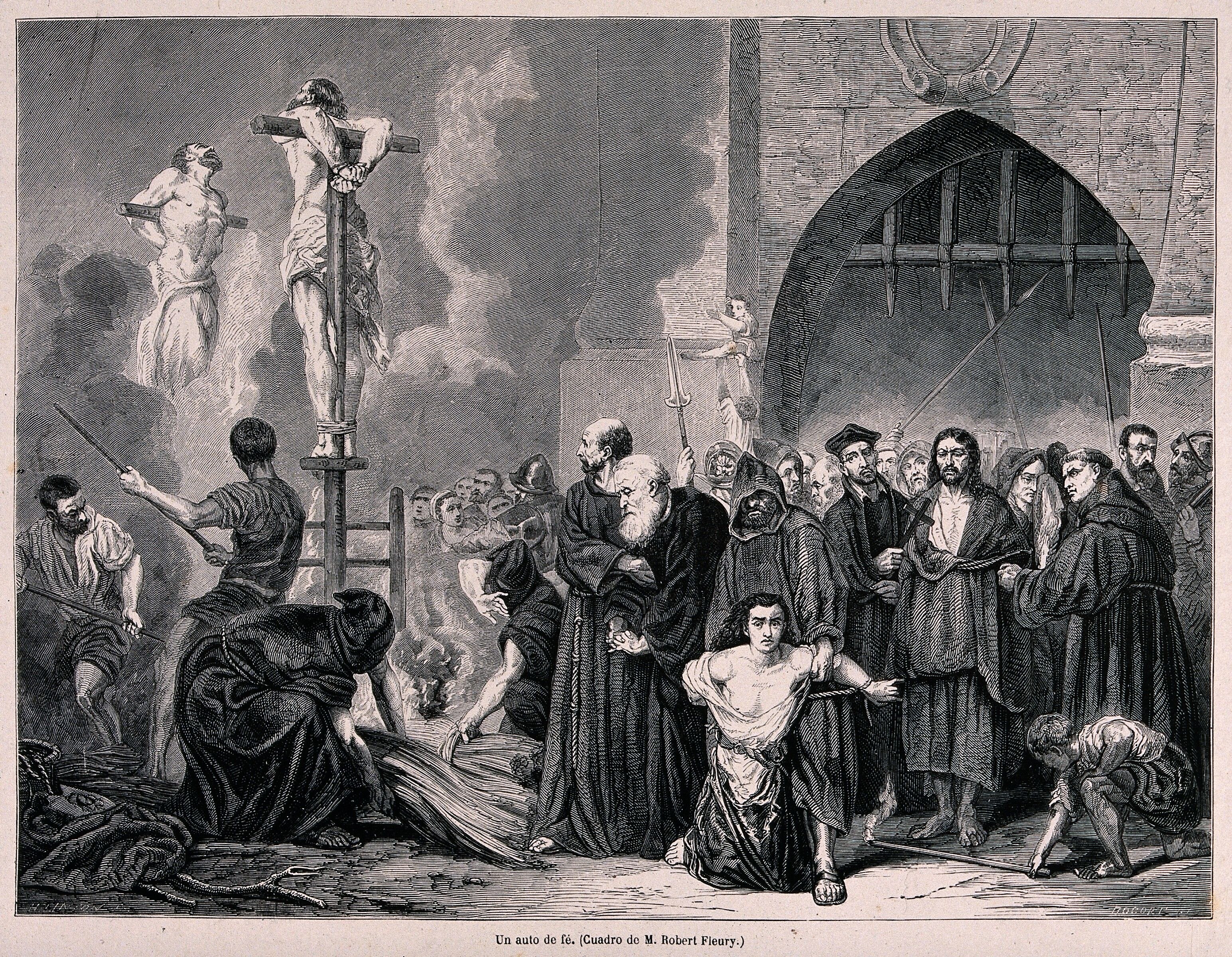
The medieval inquisitions treated belief as a legal matter. Confession was extracted under pressure. Punishments included imprisonment, torture, and execution.
The Spanish Inquisition, established in 1478 under Ferdinand and Isabella, targeted converted Jews and Muslims suspected of heresy. Trials relied on secrecy, coercion, and confession.
Violence operated through procedure and documentation. It carried legal authority and religious justification at the same time. The machinery did not need rage. It needed compliance.
Reformation Europe
The Protestant Reformation fractured Christian authority into competing systems, each claiming exclusive access to truth. Political power aligned with those claims.
In 1553, Michael Servetus was burned at the stake in Geneva under John Calvin’s authority for heresy. Catholic authorities carried out similar executions elsewhere.
The Thirty Years’ War, from 1618 to 1648, killed millions across Central Europe. Entire regions were depopulated. Religious certainty did not moderate the violence. It sustained it.
Puritan New England
Puritan leaders enforced religious conformity as a matter of covenant responsibility. Dissenters were expelled. Quakers were executed.
In 1660, Mary Dyer was hanged in Boston for repeatedly defying laws against Quaker preaching. The colony treated her return as a capital offense.
The structure prioritized uniform belief. Deviation triggered punishment.
Religious freedom in America developed later, shaped by resistance to these systems.
Slavery in the United States
American slavery was defended as consistent with Christian teaching. Pro-slavery theologians cited New Testament instructions for slaves to obey masters and used the “Curse of Ham” to frame racial hierarchy as divinely ordered.
These arguments justified forced labor, physical punishment, family separation, and control over religious instruction.
In 1807, the “Slave Bible” was published in parts of the British Caribbean. Large sections of Exodus were removed. Passages emphasizing obedience remained. The edits aligned the text with the system it supported.
Frederick Douglass described how Christianity was used to make slavery feel morally acceptable to those enforcing it. The system depended on that alignment.
Post-emancipation violence
After emancipation, violence continued under religious symbolism. Cross burning became a method of intimidation. Lynchings and organized terror campaigns were framed as defense of a Christian social order.
Photographs from the early 20th century show crowds gathered at lynchings, often after church services. The events were treated as public rituals.
Religious language provided justification and normalization for these actions. The setting made the message clear: this was acceptable.
Indigenous boarding schools
Indigenous children were removed from their families under Christian authority. Their languages and cultural practices were suppressed. Abuse was widespread. Many children died.
The Carlisle Indian Industrial School, founded in 1879, operated under the principle “Kill the Indian, save the man.” Children were renamed, punished for speaking their languages, and cut off from their families.
The system aimed to replace existing identities with a Christian framework. The results matched that aim.
A recurring pattern
Similar outcomes appear in other religious contexts when claims of divine certainty are paired with coercive power.
The mechanism is consistent. Authority grounded in revelation. Enforcement through institutions. Application to entire populations.
Change the doctrine, the structure holds.
What the record shows
Christianity has been associated with both ethical behavior and coercive systems. The presence of moral individuals does not establish the religion as a reliable source of moral constraint.
Historical evidence shows repeated instances where Christian authority justified or enforced violence when combined with political power. The pattern does not require bad actors. It requires certainty and authority.
Christianity does not own morality. The Bible does not ground it. History records the results of treating either as if they do.
The underlying dynamic
Scripture does not act independently. Interpretation and enforcement are human activities.
When a text is treated as divine authority, it can be used to legitimize hierarchy, suppress dissent, and frame obedience as moral duty.
Different groups derive conflicting conclusions from the same text while maintaining certainty in their correctness.
The constraint that mattered
Christianity persisted for centuries without enforcement power.
With enforcement power, it gained the capacity to impose belief, and produced the outcomes associated with that capacity.
The difference is not in the text. It is in who gets to enforce it.
Leave a Reply