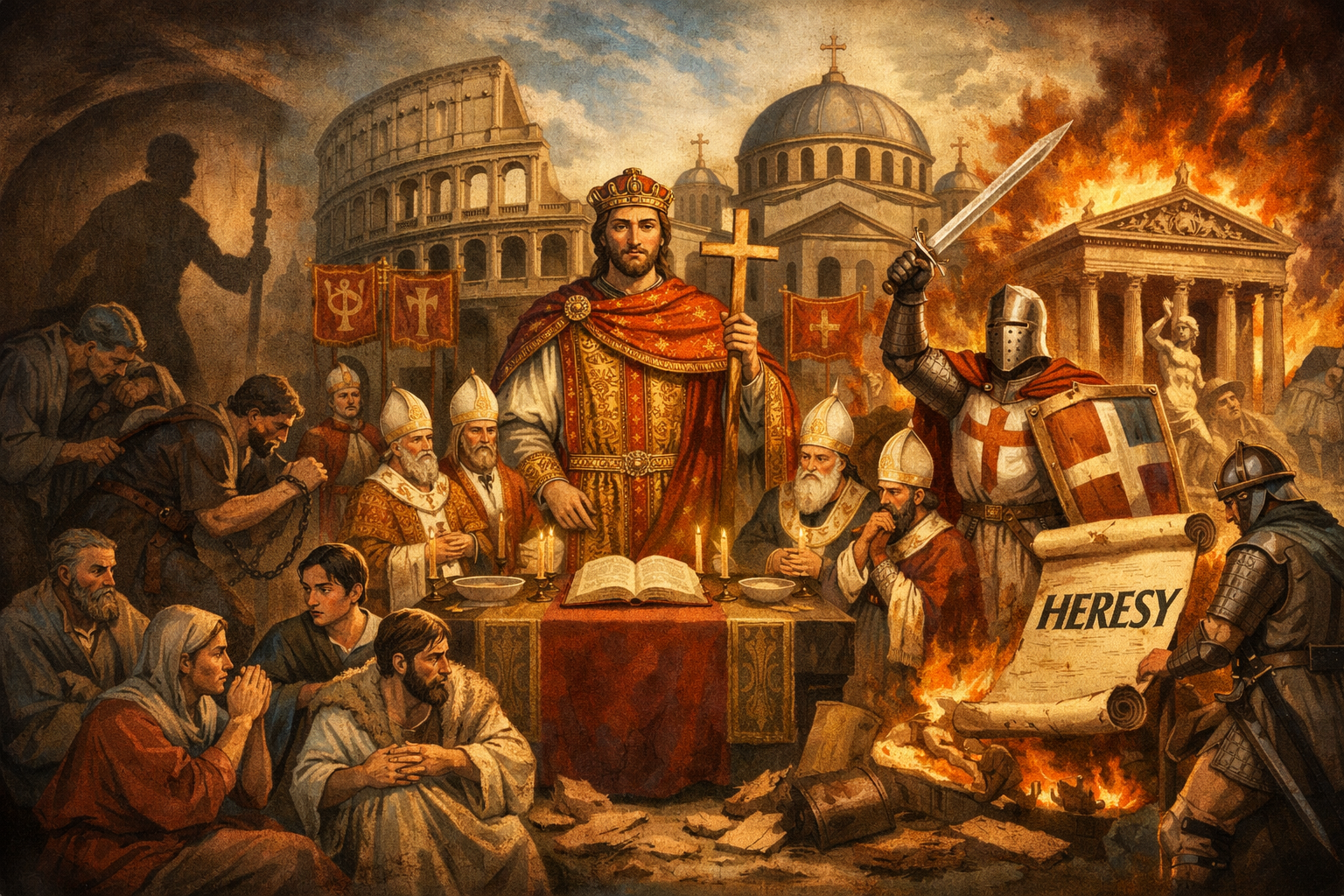
A marginal movement in a pluralistic empire
In its first centuries, Christianity was a small, often suspect movement inside the Roman Empire. Its followers met in private homes, refused public sacrifices, and declined to treat the emperor as divine. That refusal carried political meaning. In a system that tied public order to shared ritual, Christians looked less like a religion and more like a refusal to participate.
Persecution was real, but uneven. It came in bursts, usually tied to moments when authorities demanded visible loyalty. That experience shaped how Christians understood themselves. Many emphasized endurance, moral discipline, and care for the poor, with little expectation of controlling institutions or shaping law.
That picture was never uniform. Christian groups argued, excluded, and competed for authority long before any emperor took interest. But those disputes stayed inside the movement. They did not carry the force of law.
Constantine and the turn toward power
In 313 CE, Constantine issued the Edict of Milan, legalizing Christianity and ending official persecution. That alone changed the incentives. A movement defined in part by resistance was now protected by the state it had resisted.
The shift went further. In 325 CE, Constantine convened and presided over the Council of Nicaea, stepping directly into disputes over doctrine. Bishops who had once argued in letters and local councils now did so under imperial oversight. When the council produced a creed, dissenters were not just wrong. They were exposed to exile and political penalty.
This did not create disagreement. It changed what disagreement meant. Theological disputes became questions of public order, and the emperor became an enforcer of orthodoxy.
From toleration to enforcement
By the end of the fourth century, the relationship had hardened. Under Theodosius I, Nicene Christianity became the official religion of the empire. Laws followed. Traditional pagan sacrifices were banned, temples were closed or repurposed, and imperial edicts tied religious practice directly to legal consequence.
The Roman world had never offered modern religious freedom. It tolerated variety so long as public loyalty held. Christianity inherited that logic and redirected it. Now the expectation was not participation in many cults, but adherence to one.
The consequences were not theoretical. Bishops who fell on the wrong side of imperial-backed doctrine could be removed or exiled, as happened repeatedly in the Arian controversies after Nicaea. Pagan officials faced increasing restrictions in public life. Heresy was not just an error. It became a category with penalties attached.
Disagreement no longer stayed within communities. It carried consequences enforced by the state, with courts and officials acting on behalf of theological decisions.
Growth, privilege, and the cost of coercion
Imperial favor accelerated Christian expansion. Churches received land, funding, and legal standing. Clergy gained status within the administrative life of the empire. Travel became safer, communication easier, and the movement spread faster than it had as a loose network of house gatherings.
Those gains came with new tools. Courts, laws, and coercion moved from the outside to the inside. Persuasion remained, but it now operated alongside pressure. Belief was no longer only a matter of conviction. It was tied to advantage, risk, and compliance.
Theology under empire
The new arrangement forced adjustments in how Christians justified power. Earlier writers had emphasized nonviolence and endurance. That position became harder to maintain once Christians governed.
Augustine of Hippo offered a framework that helped resolve the tension. His writing on just war argued that violence could be morally justified under certain conditions, especially in defense of order. The argument did not emerge in a vacuum. It matched the needs of a church aligned with imperial authority.
The same logic extended further. The success of Christianity was taken as evidence of divine favor. The empire’s victories and stability could be read as signs of God’s will. Opposition to imperial order could then be framed as opposition to that will.
Orthodoxy, heresy, and the winners of history
Christianity did not become unified overnight. Competing interpretations persisted across regions for centuries. What changed was which version had the backing to survive.
The groups that lost these struggles were not simply persuaded. Many were suppressed, sidelined, or written out of the record. What later generations received as orthodoxy was the strand that aligned with power and endured under its protection.
From imperial Christianity to modern claims
The merger of religious and political identity did not end with Rome. Once belief becomes tied to loyalty, the boundary between faith and citizenship narrows. To belong is to believe the right things in the right way.
That pattern reappears whenever a state claims a religious identity as part of its legitimacy. The language changes. The structure does not. When belief is backed by law, dissent becomes disobedience, and faith takes on the function of policy.
The early centuries of Christianity show the shift in slow motion. A movement that began without political power learned how to use it, justify it, and defend it. The costs were concrete. They showed up in who could hold office, who could worship openly, and who was removed, punished, or excluded for refusing.
That is the part that tends to get softened or skipped. The record is clear enough without exaggeration.
Leave a Reply